Plan enzyme trials that can survive the production floor
Yieldwright Labs is an industrial enzyme trial supplier for factories that need more than a product recommendation. We help process improvement teams define where an enzyme may reduce heat load, chemical demand, residence time, rework, cleaning intensity, or yield loss — then structure the pilot so plant teams can validate the result under real constraints.
We support controlled trials using amylase, protease, lipase, cellulase, and related enzyme classes for industrial processing environments. The focus is practical: define the process target, choose the trial window, control the variables, supply suitable trial quantities, and measure the KPI shift before scale-up decisions are made.
Enzyme trials designed for factory risk control
A useful enzyme pilot is not just a dosing test. It needs a baseline, defined operating limits, sampling discipline, changeover planning, and a decision gate that plant leadership can trust.
Yieldwright Labs helps teams turn an improvement idea into a structured factory trial:
- Identify the process step where enzymes may create measurable value
- Select the enzyme class and supply format suited to the material stream
- Define dose ranges without disrupting throughput or product quality
- Establish baseline KPIs before the trial starts
- Set pass/fail criteria for production-floor validation
- Supply trial quantities through a quote-based B2B process
- Support the path from bench indication to plant-side proof
Where enzymes can create measurable factory value
We work with factories assessing enzyme use where existing processes rely heavily on chemicals, heat, time, or manual correction.
Starch and carbohydrate processing
Amylase trials may support viscosity reduction, starch conversion, faster liquefaction, improved handling, or reduced downstream process stress. Trial design typically focuses on temperature profile, residence time, solids handling, and measurable product or throughput outcomes.
Protein-containing waste, soils, or process streams
Protease trials may help reduce cleaning burden, improve breakdown of proteinaceous residues, support recovery steps, or reduce harsh chemical dependency. The pilot should measure both process effect and compatibility with materials, equipment, and discharge constraints.
Fat, oil, and grease management
Lipase trials may support targeted breakdown of lipid residues, separation improvements, cleaning process optimization, or reduction of persistent buildup. Trial structure should account for emulsification behavior, pH range, temperature exposure, and downstream handling.
Fiber, biomass, and plant material handling
Cellulase trials may support fiber modification, improved extraction, viscosity control, or breakdown of plant-based residues. The right pilot examines contact time, particle behavior, solids loading, and the effect on product or waste-stream performance.
Built for process improvement managers
Your team needs evidence before changing a validated process. We design enzyme trials around the concerns that determine whether a pilot is useful:
- Operational fit: Can the enzyme be dosed, mixed, and held within the existing production sequence?
- KPI relevance: Which metric proves value — yield, throughput, viscosity, chemical reduction, cycle time, rework, cleaning time, or waste burden?
- Quality protection: What product attributes, residues, or downstream requirements must not be compromised?
- Trial containment: Can the plant run the pilot in a defined window without risking broader production?
- Scale-up logic: If the pilot passes, what has to change before routine use?
The Yieldwright trial path
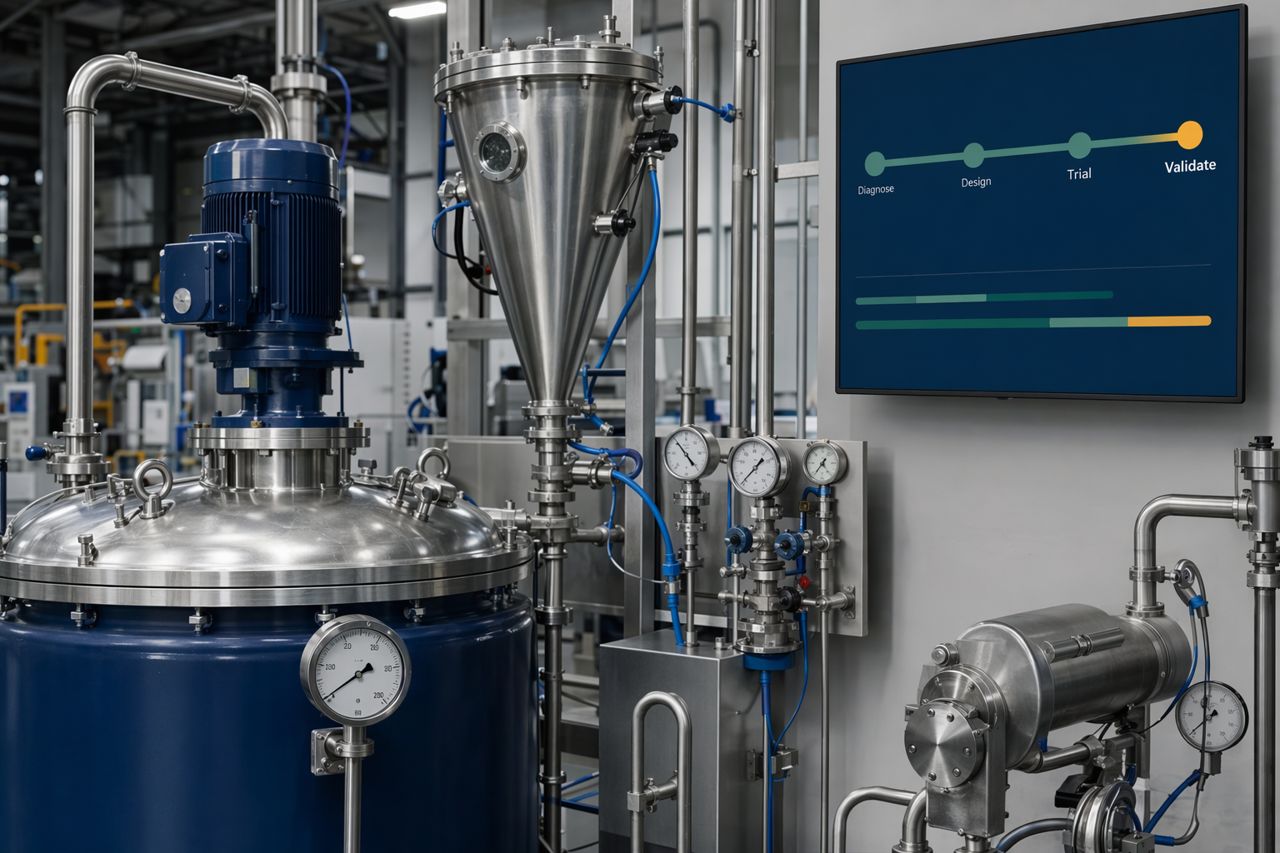
1. Diagnose the process target
We begin with the production step, not the enzyme catalog. Your team shares the material stream, current operating conditions, limiting factors, and target KPI. We identify where an enzyme trial is technically plausible and where it is unlikely to justify plant time.
2. Design the pilot structure
We define the comparison: baseline versus enzyme-assisted condition. This includes trial scope, dose range logic, sampling points, hold times, monitoring requirements, and the operational limits that cannot be crossed.
3. Supply the trial material
We quote suitable enzyme trial quantities for controlled plant validation. Supply recommendations are matched to the intended application, handling conditions, and trial size. We do not push unnecessary volume before proof is established.
4. Measure against decision KPIs
The trial is judged against agreed operational metrics. Typical KPIs include reduced process time, improved flow, lower chemical input, reduced heat demand, improved recovery, lower rework, faster cleaning, or more stable downstream handling.
5. Validate the scale-up case
If the trial shows value, we help define the next gate: repeat run, larger production window, economic review, procurement specification, and routine dosing plan.
What we need to quote a factory trial
To prepare a useful quote, share the practical details your operators already know:
- Industry and process step under review
- Material stream or substrate description
- Current process temperature, pH range, and residence time
- Existing chemical, heat, or mechanical treatment
- Target improvement and required KPI
- Approximate trial volume or production window
- Equipment constraints, dosing access, and mixing limitations
- Any product quality, cleaning, discharge, or regulatory constraints
If some data is not available, we can still help scope a first-pass trial plan.
Why factories choose Yieldwright Labs
- Trial-first thinking, not generic enzyme positioning
- Clear pilot gates that reduce production risk
- Commercially grounded recommendations for plant validation
- Practical support across amylase, protease, lipase, cellulase, and related enzyme classes
- Quote-based B2B supply for measured trials before scale-up
- Documentation-oriented communication for engineering, operations, procurement, and quality teams
Start with a controlled pilot
If your team is evaluating enzymes to reduce chemicals, heat, time, rework, or waste burden, start with a scoped trial rather than an open-ended test.
Use the request form below to describe the process step, target KPI, and preferred trial window. Yieldwright Labs will respond with a practical quote and recommended next step.
Request a quote
Submit your process details through the on-site request form. Include the enzyme class if known, or describe the production constraint you want to improve. We will review the fit, flag any obvious trial risks, and prepare a quote for suitable factory trial supply.